
Vault tie-in under a Kierland Commons retail pad
Post-paving TI cannot trench across valet circulation to reach switchgear. HDD links manholes under asphalt with pits offset from striping and landscape islands.
Scottsdale, AZ · Maricopa County
Steerable HDD under Scottsdale paver courtyards, Kierland pads, and ADOT Loop 101 relocations — mud programs for foothill granite, caliche, and resort-corridor utility stacks.
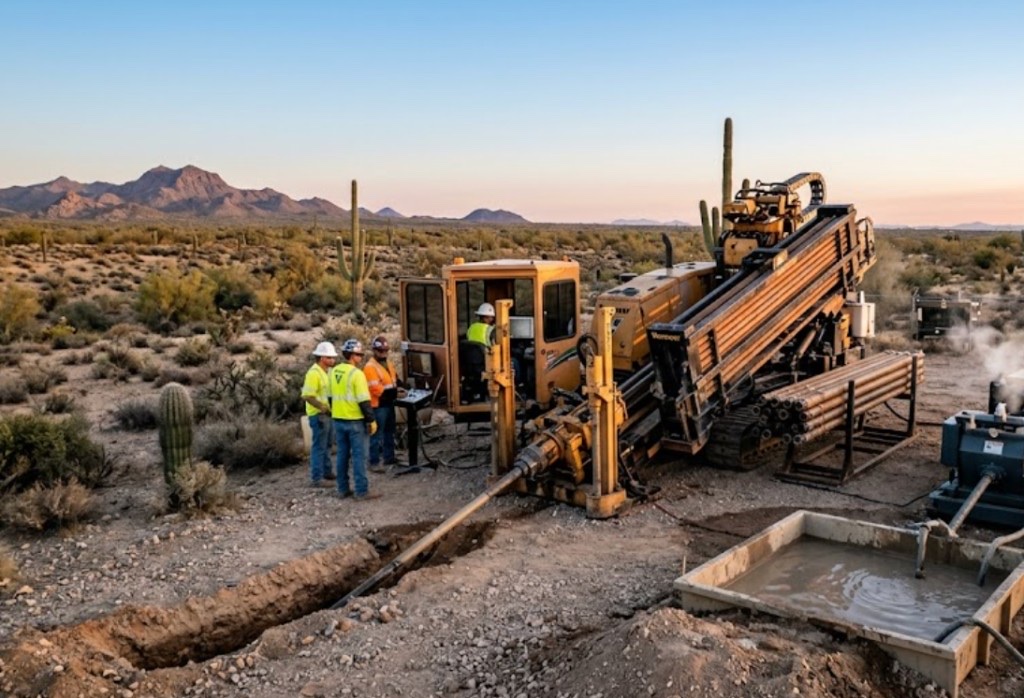
Horizontal directional drilling in Scottsdale is how DC Ranch and McCormick Ranch owners replace sewer and water lines under courtyard walls and circular drives without surrendering golf-community hardscape to open-cut restoration. General contractors on Kierland and North Scottsdale medical TI work pull duct bank between vaults after pavers are set — valet lanes stay open while conduit crosses under the lot.
Scottsdale's shallow utility stack — APS secondary, SRP Arizona Canal laterals, city water and sewer, resort fiber, and gas — means HDD starts with Arizona 811 and hand holes at paint conflicts before rig mobilization. Directional Boring Arizona matches spread size to greenbelt sand versus Troon granite cobble, not a generic East Valley template.
Directional boring in Scottsdale on Loop 101 and Scottsdale Road frontage layers ADOT MOT, SRP canal easement rules, and HOA landscape bond awareness on standard locate discipline. Old Town hospitality upgrades add night-window bores when daytime lane closure on Camelback or Indian School is off the table.
Real Maricopa County angles — not generic statewide copy.
Post-paving TI cannot trench across valet circulation to reach switchgear. HDD links manholes under asphalt with pits offset from striping and landscape islands.
Failed lateral under rock mulch and courtyard walls — steerable bore from meter to cleanout preserves hardscape open-cut would rebuild.
ADOT widening stacks relocations under state ROW. HDD narrows lane closure versus open trench; night windows scoped before booking.
Gated parcel with shallow congestion and security hold points — cased approaches where open trench would breach landscape bonds.
Scottsdale HDD crews confirm survey and locate paint — two business days minimum on 811, longer when ADOT or SRP canal easements control the path. Pits are shored for caliche or decomposed granite; mud weight rises near Indian Bend Greenbelt fill. Pilot, ream, and pullback are monitored for buoyancy on long HDPE pulls through north-valley alluvium.
Scottsdale mixes McDowell foothill decomposed granite, valley caliche, and Arizona Canal alluvium — north Scottsdale cobble and boulder fields slow pilots without matched mud programs.
Most Scottsdale bores hit caliche crust between 2 and 8 feet, then alluvial sand or decomposed granite depending on distance from the McDowells. North Scottsdale and Troon shots add mountain fan cobble and boulder fields that slow penetration without correct tooling. Greenbelt-adjacent parcels carry sandy fill with seasonal groundwater after monsoon storms — buoyancy management matters on long HDPE pulls. We size ream stages for Scottsdale geology, not a generic Phoenix valley template.
Sonoran heat, north-valley wind, and monsoon outflows shape Scottsdale bore schedules — Indian Bend Wash sheet flow and afternoon lightning holds are planned into quotes.
Monsoon season from July through September softens greenbelt-adjacent ROW and can delay entry pits on sandy fill. Spring wind on exposed north Scottsdale pads affects cage and fluid handling along Shea and Pima. Summer heat above 110°F slows morning startup on exposed sites but rarely stops work — we communicate when dry conditions matter for granite-heavy pits rather than risk frac-outs toward the Indian Bend Wash.
City of Scottsdale Development Services, Maricopa County ROW, ADOT District, SRP Arizona Canal easements, and tribal-community coordination apply on many alignments.
Inside Scottsdale city limits, street cuts, driveway removals, and greenbelt-adjacent work may need Development Services permits. Maricopa County ROW rules apply on unincorporated pockets toward north Scottsdale. ADOT controls Loop 101 and state highway bores — expect traffic control plans and sometimes night-only windows on resort frontage. SRP Arizona Canal easements add coordination beyond standard 811. HOA and resort properties may add landscape bond and restoration review on pit placement.
Open-cut across a McCormick Ranch courtyard or Kierland valet lane often costs more in pavers, mature trees, and business interruption than the bore. HDD wins when canal laterals and APS share the first few feet, when hardscape cannot be sacrificed, or when ADOT ROW limits trench width.
Footage, diameter, caliche versus rock, dewatering, traffic control, permit fees, utility density, and rig class — quoted as drivers, not a menu price.
You share plans or describe the problem; we confirm alignment, depth, access, and which trenchless method fits Arizona soils.
Arizona 811 ticket filed; two business days minimum before pits open unless your permit path differs. We pothole where marks conflict.
Bore plan, ADOT or city ROW permits, railroad agreements, and crossing engineering when the path leaves private property.
Compact spread for tight Scottsdale lots; larger HDD for I-17 or Loop 101 relocations — matched to length and diameter.
Steered pilot on design line, ream passes sized for your pipe or casing, fluid program tuned for caliche or decomposed granite.
HDPE fusion, steel casing, or multi-duct bundle pulled with tension and bend-radius monitoring.
Pressure test, mandrel, or survey records for owners, inspectors, and operators as spec requires.
Compact pits, replace gravel or hardscape per scope, leave 811 ticket and locate map in your project file.
Scottsdale HDD pricing follows length, diameter, granite or caliche, utility density, HOA restoration, and permitting — not a flat per-foot rate. Send your alignment for a free estimate with cost drivers listed.
Yes — decomposed granite and caliche are common. Mud programs, ream sequence, and pullback speed limit frac-outs along greenbelt banks. Saturated ground after monsoon rain may require schedule shifts.
Arizona dig law requires two full business days after ticket submission. Congested corridors on Scottsdale Road and Shea often need remark tickets and hand holes at conflicts.
Yes — daily mobilization across Scottsdale with the same 811 discipline. Permitting and HOA rules shift by neighborhood.
Often yes — pits offset from hardscape and a steerable path under the slab. Some tie-ins need a small access cut; we flag that in the quote.
24/7 — Emergency dispatch statewide. Tell us entry, exit, pipe size, and county — a bore specialist calls back with cost drivers, not a flat rate.
Scope your alignment
Step 1 of 2 — path, pipe, and city first